Counting with Python
by xiangxiang
counting有个高大上的名字叫组合数学
- 0x00 Overview
- 0x01 Sum rule
- 0x02 Product rule
- 0x03 Tuples
- 0x04 Permutations
- 0x05 Combinations
- 0x06 Pascal’s Triangle
- 0x07 Combinations with repetitions
- 0x08 Tricks
0x00 Overview
0x01 Sum rule
1.1 Sum rule
Generalized Rule of Sum
\[|A \cup B| = |A| + |B| - |A \cap B|\]- If there are $n$ objects of the first type and there are $k$ objects of the second type, then there are $n+k$ objects of one of two types.
- when applying the sum rule, one should ensure that no object belongs to both classes
1.2 Code
- In practice, use set
a = {1, 2, 3}
b = {2, 3, 4}

c = a.union(b)
c = a | b      # the union operation is also denoted by | in Python
0x02 Product rule
2.1 Product rule
\[A \times B = \{(a, b): a \in A, b\in B\}\] \[|A \times B| = |A| \times |B|\] \[A_1 \times ... \times A_k = \{(a_1, ...,a_k): a_1 \in A_1, ..., a_k \in A_k\}\] \[|A_1 \times ... \times A_k| =|A_1| \times ... \times |A_k|\]2.2 Code
from itertools import product

a = (1, 2, 3)
b = (5, 6, 7)

a_times_b = product(a, b)
print(list(a_times_b))
0x03 Tuples
3.1 Number of tuples
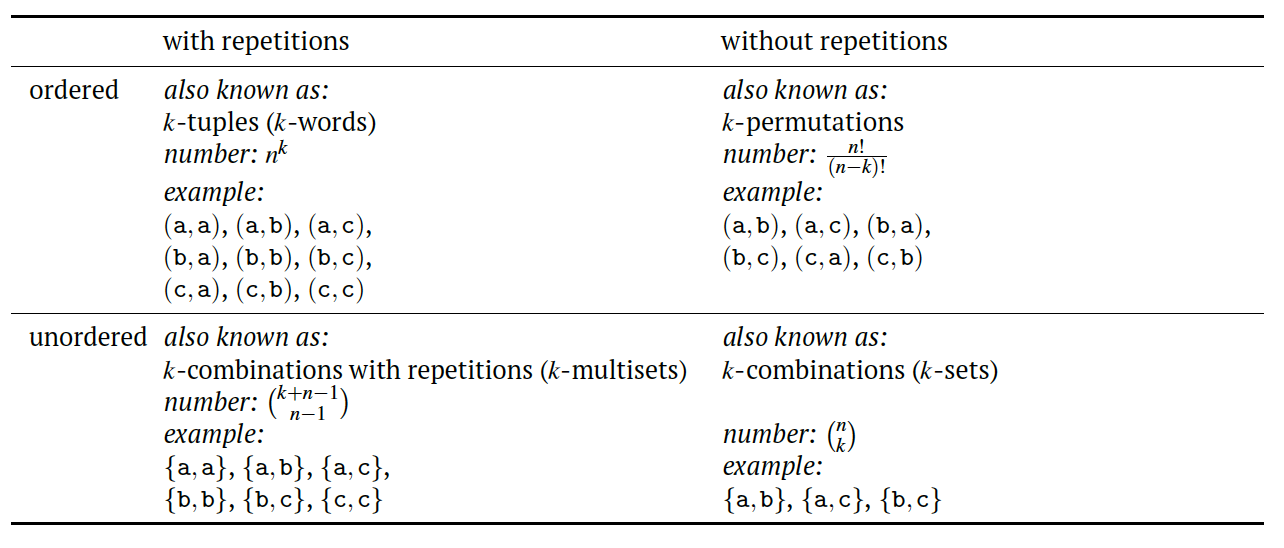
The number of sequences of length $k$ composed out of $n$ symbols is $n^k$
3.2 Code
from itertools import product

a = (1, 2, 3)

a_tuples = product(a, repeat=2)
print(list(a_tuples))
0x04 Permutations
4.1 k-permutations
The number of sequences of length &k& with no repetitions composed out of $n$ symbols is $k$-permutations over $n$ symbols = $n(n-1)(n-2)…(n-k+1)$
4.2 Code
from itertools import permutations
a = (1, 2, 3)
two_permutations = permutations(a, 2)
print(list(two_permutations))
0x05 Combinations
5.1 n choose k
- For a set $S$, its $k$-combination is a subset of $S$ of size $k$
- Each subset is counted $k!$ times if using $k$-permutations, make sure that each object is counted once
- The number of $k$-combinations of an $n$ element set is denoted by ${n \choose k}$
- ${n \choose k}$ Pronounced “n choose k”
5.2 Code
from itertools import combinations

a = (1, 2, 3)
two_combinations = combinations(a, 2)
print(list(two_combinations))
0x06 Pascal’s Triangle
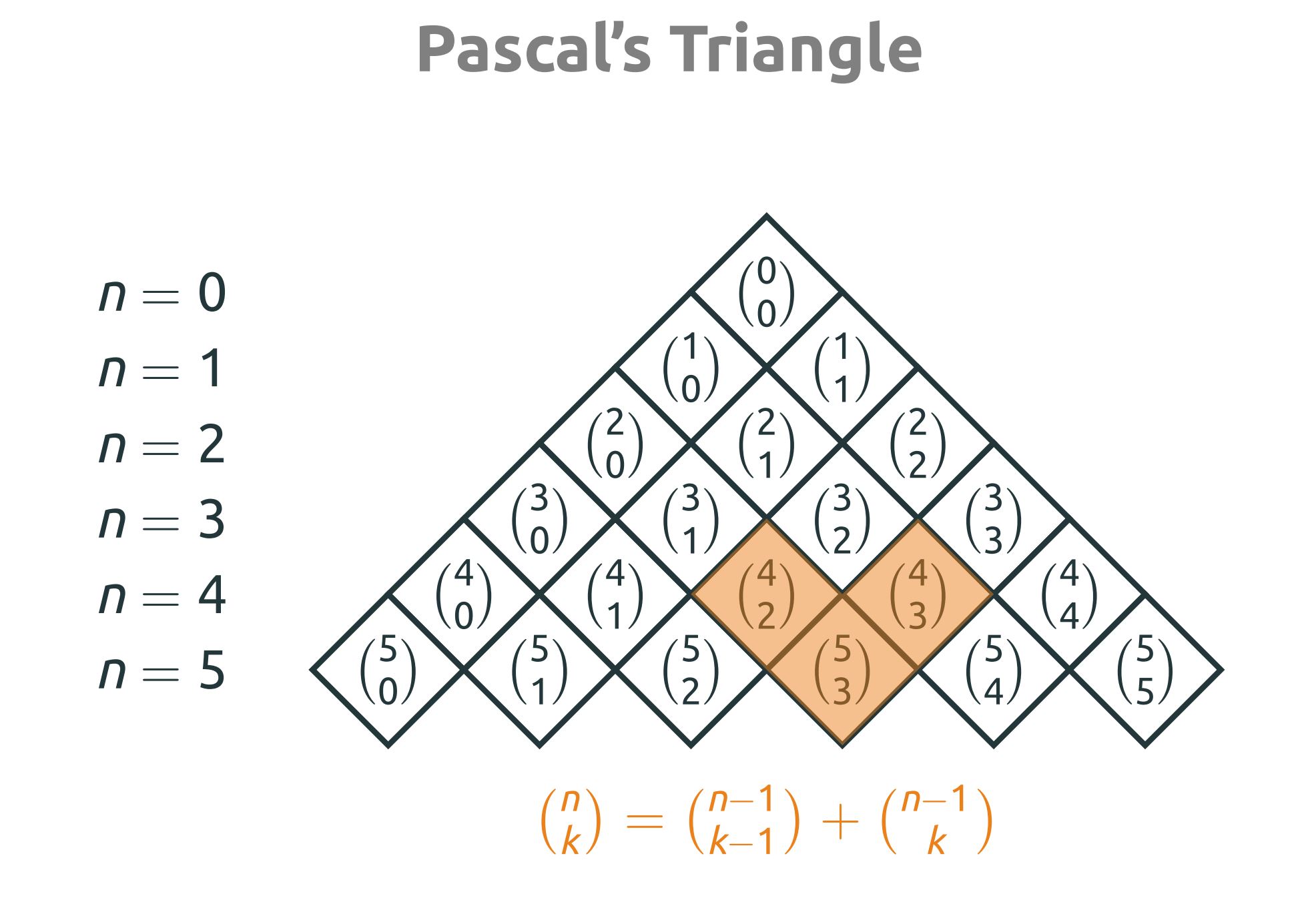
\[{n \choose k} = {n-1 \choose k-1} + {n-1 \choose k}\]6.1 Proof
Proof: choose k students from n students to form a team ${n \choose k}$
Fix one of the students, call her Alice There are two types of teams:
- Teams with Alice: ${n-1 \choose k-1}$
- Teams without Alice : ${n-1 \choose k}$
Hence ${n \choose k} = {n-1 \choose k-1} + {n-1 \choose k}$
6.2 Picture
6.3 Pascal’s Triangle is Symmetric
\[{n \choose k} = {n \choose n-k}\]6.4 Row sums
- Can be proved by induction
- Can be proved by construct a one-to-one correspondence between odd size subsets and even size subsets
For n > 0,
\[\sum_{k=0}^{n}{(-1)^k {n \choose k} } = 0\]Need to show that
\[{n \choose 1} + {n \choose 3} + ... = {n \choose 0} + {n \choose 2} + ...\]Construct a one-to-one correspondence between odd size subsets and even size subsets
- Fix any element x (can do this since n > 0)
- Partition all subsets into pairs $(A, B)$ where $A = B \cup {x}$
- One of A, B has odd size, the other one has even size
6.5 Binomial Theorem
\[(a+b)^n = \sum_{k=0}^{n}{ {n \choose k} a^{n-k}b^k}\]Consequences
-
set $a=1, b=1$, ${n \choose 0} + {n \choose 1} +…+ {n \choose n} = 2^n$
-
set $a=1, b=-1$, $\sum_{k=0}^{n}{(-1)^k{n \choose k}} = 0$
-
set $a=1, b=2$, $3^n = {n \choose 0} + {n \choose 1}2 + {n \choose 2}2^2 + … + {n \choose n}2^n$ Combinatorial proof:
- $3^n$ is the number of words of length $n$ over the alphabet {x, y, z}
- ${n \choose 0}$ is the number of words consisting of the letter x only
- ${n \choose 1}2$ is the number of words with exactly $n − 1$ letters x
- ${n \choose 2}2^2$ is the number of words with exactly $n − 2$ letters x
6.6 Code
C = dict()  # C[n, k] is equal to n choose k

max_n = 8

for n in range(max_n):
    C[n, 0] = 1
    C[n, n] = 1

    for k in range(1, n):
        C[n, k] = C[n-1, k-1] + C[n-1, k]


print(C[4, 3])
0x07 Combinations with repetitions
7.1 Combinations with repetitions
- Combinations with repetitions are unordered selections with repetitions.
- Also known as multisets
- The number of $k$-combinations with repetitions selected out of $n$ objects is
Proof:
- In short, a $k$-combination with repetitions is specified by $k$ stars and $n−1$ bars, hence the answer is $$
- Choose $k$ stars
- We need $n−1$ bars to split all stars into $n$ groups
- To specify such a sequence, one needs to select positions for $n−1$ bars out of all $k+n−1$ positions
- Thus, the total number of kk-combinations with repetitions is ${k+n-1 \choose n-1}$
Note that instead of selecting $n−1$ positions for bars, one could as well select $k$ positions for stars (all the remaining positions are filled with bars). This leads to the answer ${k+n-1 \choose k}$ , which is equal to ${k+n-1 \choose n-1}$ by Pascal’s rule.
Example: k=4, n=3
012345
****||
***|*|
***||*
**|**|
**|*|*
**||**
*|***|
*|**|*
*|*|**
*||***
|****|
|***|*
|**|**
|*|***
||****
7.2 Code
from itertools import combinations_with_replacement

a = (1, 2, 3)
two_combinations = combinations_with_replacement(a, 2)
print(list(two_combinations))
0x08 Tricks
8.1 Bijection rule
A bijection between two sets $A$ and $B$ proves that the cardinalities of $A$ and $B$ are the same.
Example
Consider 10 points on a circle.
A: One can draw many triangles whose vertices are chosen among these points.
B: Also one can draw many 7-gons whose vertices are chosen among these points.

triangle (3 points) <---> 7-gons(the other 7 poins)

|A| = |B|
8.2 Complement rule
The number of objects satisfying a certain property is equal to the total number of objects minus the number of objects that do not satisfy the property
if $A \subseteq U$, then $|A| = |U| - |U \setminus A|$
tags: python math combinatorics